1. What is PayLater? Executive Summary & Technical Architecture
In modern e-commerce, the single greatest friction point in the customer journey is the final checkout total. High upfront price tags cause cart abandonment rates to surge above 70%, particularly during mid-month periods before payday.
PayLater is AddQart's integrated flexible installment gateway that directly solves this friction. It empowers online shoppers to divide their total purchase into 4 equal, interest-free installments, payable over time, while granting the merchant immediate, 100% upfront payment settlement.
Technical Architectural Pillars
<PayLaterWidget />).+-------------------------------------------------------------------------------+
| HOW PAYLATER TRANSACTIONS FLOW |
+-------------------------------------------------------------------------------+
| 1. Shopper chooses PayLater at Checkout -> Instant OTP mobile verification |
| 2. Customer pays 1st installment (25%) today -> Order confirmed instantly |
| 3. AddQart Engine verifies HMAC Webhook -> Order moves to "Processing" |
| 4. Merchant receives 100% UPFRONT SETTLEMENT directly in their bank account |
| 5. PayLater collects remaining 75% over 3 months with ZERO merchant risk |
+-------------------------------------------------------------------------------+2. How PayLater Works: Customer Experience vs. 100% Upfront Merchant Settlement
To understand why PayLater drives immense revenue, one must understand how the transaction bifurcates between the consumer and the retailer.
The Consumer Journey (Friction-Free Checkout)
The Merchant Journey (100% Upfront Cash Flow)
Many merchants incorrectly assume that offering installment payments ties up their working capital. With PayLater on AddQart, the exact opposite occurs:
3. The Conversion Engine: +35% Conversions & +45% AOV Surge
Data across thousands of digital storefronts demonstrates that activating PayLater transforms retail unit economics across three core metrics:
| Performance Metric | Without PayLater (Cards & COD Only) | With PayLater Activated | Net Impact |
|---|---|---|---|
| Checkout Conversion Rate | 2.1% - 2.8% | 3.4% - 4.2% | +35% Lift |
| Average Order Value (AOV) | QAR 260 | QAR 385 | +48% Surge |
| Cart Abandonment Rate | 72.4% | 53.1% | -19.3% Reduction |
| Cash on Delivery (COD) Share | 45.0% | 18.0% | -60% COD Risk Reduction |
Breaking the "Month-End" Bottleneck
In retail markets across Qatar and the GCC, consumer liquidity fluctuates around the monthly salary cycle (days 25 to 30). Between days 10 and 24, high-intent shoppers frequently abandon carts because they are unwilling to part with large sums of cash before their next paycheck.
PayLater eliminates this barrier. Because shoppers only commit 25% today, buying decisions shift from deliberation to instant action, sustaining peak conversion rates throughout the entire calendar month.
Slashing Return Rates from Cash on Delivery (COD)
In the Middle East, Cash on Delivery suffers from return rates exceeding 25% to 35% due to buyer remorse and failed courier deliveries. By migrating COD customers to PayLater:
4. The 0% Fee Advantage: AddQart vs. Shopify's 2% Penalty Tax
Payment gateway economics are where platforms either empower retailers or drain their profits.
+---------------------------------------------------------------------------------+
|                       ANNUAL PLATFORM FEE ON PAYLATER SALES                     |
|                      (Based on $1,000,000 Annual Sales Volume)                  |
+---------------------------------------------------------------------------------+
| Shopify Basic/Shopify Plan (2.0% Penalty):      $20,000 Platform Penalty Fee    |
| Shopify Advanced Plan (0.6% Penalty):           $6,000 Platform Penalty Fee     |
| AddQart Commerce OS:                            $0 (Strictly 0% Platform Fee)   |
|                                                                                 |
| NET RETAINED ANNUAL PROFIT ON ADDQART:          +$6,000 to +$20,000 SAVED       |
+---------------------------------------------------------------------------------+
On legacy platforms like Shopify, connecting any regional payment rail or BNPL provider triggers a punitive 1.0% to 2.0% third-party gateway penalty on every single transaction, over and above the gateway's merchant discount rate.
On AddQart, all merchants benefit from 0% platform transaction fees across all plans. Every riyal or dirham generated via PayLater goes straight into your merchant bank account, preserving your gross margins.
5. Step-by-Step Dashboard Setup: The Exact AddQart Configuration Flow
Enabling PayLater on AddQart is fully turnkey and takes less than 60 seconds. Here is the exact walkthrough inside your AddQart Merchant Dashboard:
[AddQart Dashboard] -> [Settings] -> [Payments] -> [PayLater]Step 1: Open the PayLater Gateway Page
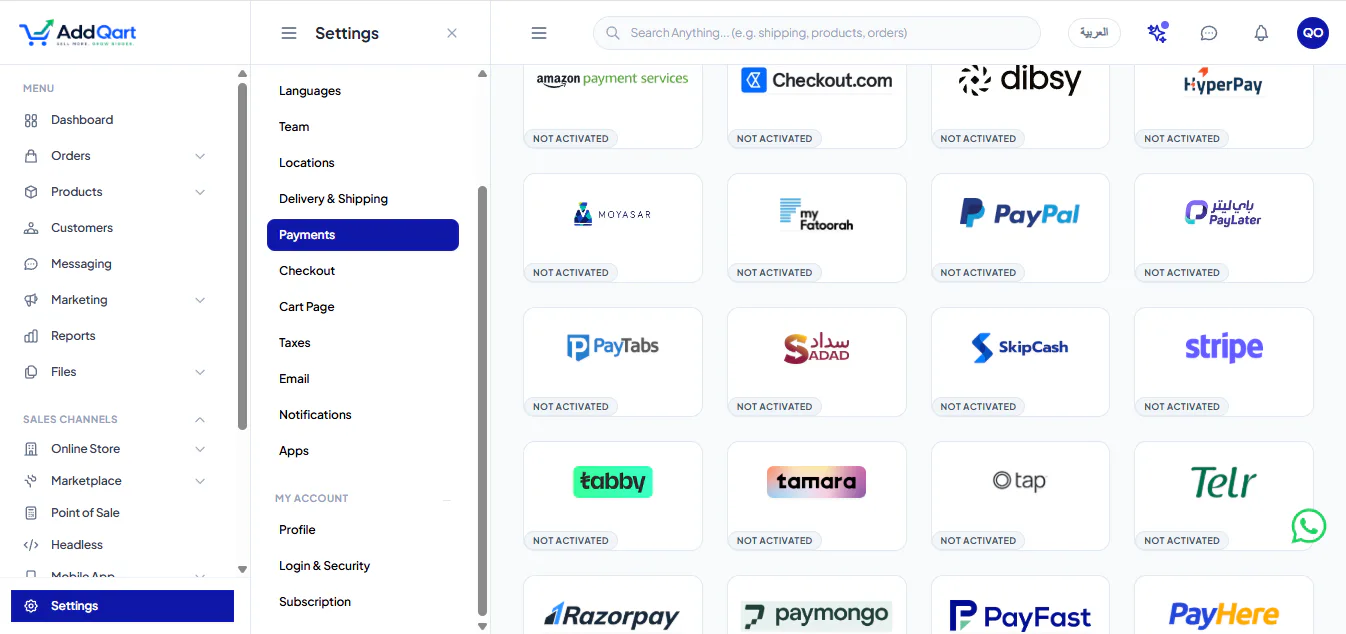
In your merchant sidebar, navigate to Settings → Payments. Locate PayLater in the gateway grid and click on it to open the configuration panel at /settings/payments/paylater.
Step 2: Configure Your Credentials
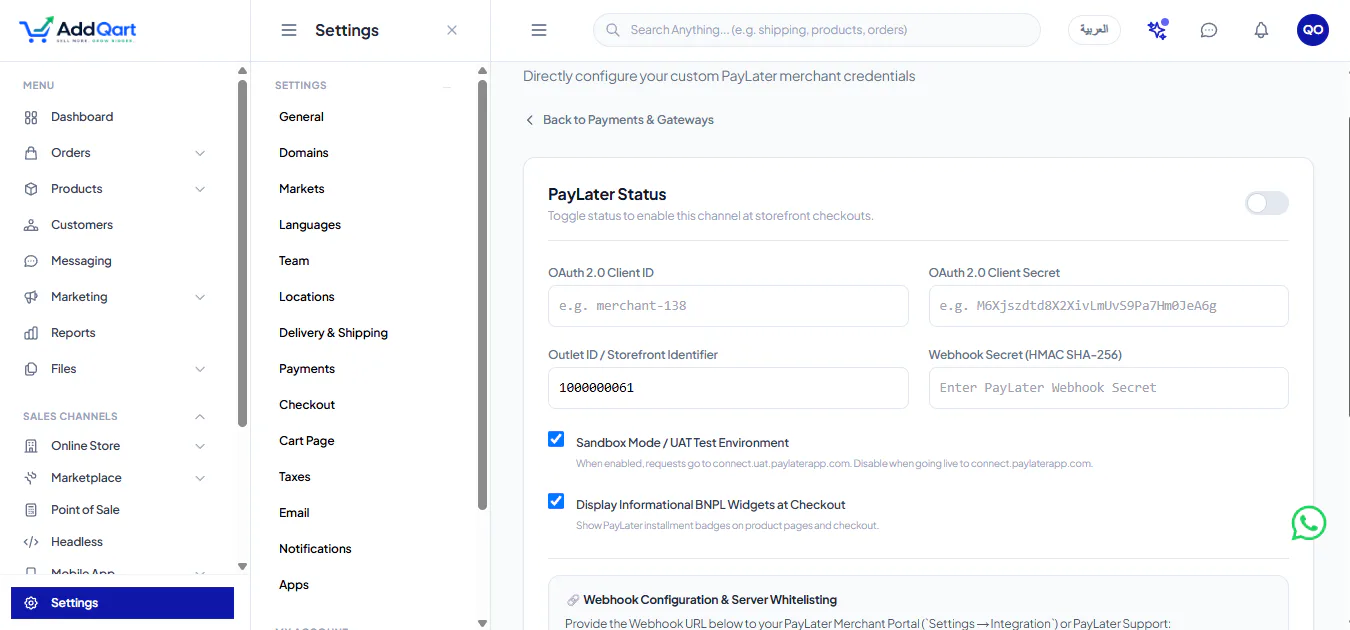
Enter the parameters provided by your PayLater account manager:
Input your assigned client identifier (e.g. merchant-138).
Paste your secret key used to generate bearer authentication tokens.
Your unique terminal or storefront identifier (e.g. 1000000061).
The HMAC SHA-256 secret key used by AddQart to cryptographically verify asynchronous payment callback payloads.
https://connect.uat.paylaterapp.com).https://connect.paylaterapp.com).Leave checked to automatically enable installment badges across your product pages and checkout.
Step 3: Copy Your Webhook URL
In the PayLater settings panel, look for the Webhook Configuration & Server Whitelisting box.
https://api.addqart.com/api/webhooks/paylater
Settings → Integration or email it directly to your PayLater integration support team.Step 4: Whitelist the AddQart Server Domain
If your PayLater enterprise agreement requires origin firewall whitelisting, submit the AddQart backend domain to PayLater support:
api.addqart.comStep 5: Run the Live API Connection Test
Before enabling live transactions, click the "Test API Connection" button located directly inside the dashboard.
/oauth/token)."PayLater OAuth 2.0 handshake verified successfully!"
6. Storefront Installment Widgets & Checkout UX Best Practices
Merchants often make the mistake of only displaying installment options on the final checkout page. By that point, price-sensitive shoppers have already abandoned their session.
To maximize revenue, AddQart includes native, automated merchandising widgets throughout the customer journey:
1. The Product Page Installment Badge
AddQart's built-in <PayLaterWidget /> automatically computes 4-split payments dynamically client-side without slowing down page load:
<PayLaterWidget
  price={currentPrice}
  currency={currencyCode || "QAR"}
  enabled={payLaterShowWidgets}
/>
The badge features a modern purple-and-cyan brand badge displaying:
PAY WITH PAYLATERPay QAR 125.00 today (for a QAR 500 product)INTEREST-FREE2. The Cart Slide-Over Preview
Before shoppers reach checkout, the cart drawer previews their 4-split payment amount, reassuring them that their purchase fits comfortably within their monthly budget.
3. The Dedicated Checkout Tile
During checkout, PayLater appears alongside Credit Cards, NAPS, and Apple Pay as an intuitive radio tile labeled "PayLater BNPL". Selecting PayLater smoothly redirects the customer to the secure web-checkout link (/api/paylater/merchant-portal/v2/web-checkout/link) and redirects back upon successful verification.
7. Security, Regulatory Compliance & Zero Merchant Default Risk
Offering flexible installments requires adherence to stringent banking and consumer credit protocols. AddQart and PayLater ensure enterprise-level compliance from day one:
Cryptographic Webhook Security
Every transaction callback received from PayLater at https://api.addqart.com/api/webhooks/paylater is validated against your webhook_secret using an HMAC SHA-256 signature check. Tampered or forged requests are rejected at the edge before touching your database or order statuses.
Zero Merchant Credit Risk
Retailers never take on debt or liability. If a consumer fails to pay their second, third, or fourth installment:
Data Privacy & PCI DSS
Customer credit card and banking details are captured inside PayLater's PCI-DSS Level 1 certified vault. No sensitive credit card numbers or banking passwords ever touch your AddQart storefront servers, ensuring complete compliance with regional data protection mandates.
8. Search-Intent FAQs: Everything Merchants Need to Know
What is PayLater on AddQart?
PayLater is an integrated flexible payment solution that allows e-commerce shoppers to divide their total purchase into 4 equal, interest-free installments. The customer pays 25% today, while the merchant receives 100% upfront settlement into their bank account within 1-2 business days.
Do merchants assume any risk if a customer defaults?
No. Merchants assume 0% default risk. PayLater fully underwrites and manages all installment collections. If a shopper delays or defaults on payment, the merchant retains 100% of their revenue without any chargebacks or clawbacks.
What are the exact fields required in the AddQart Merchant Dashboard?
To configure PayLater under Settings → Payments → PayLater, you need:
client_id)client_secret)outlet_id)webhook_secret)sandbox)show_widgets)How do I verify that my PayLater credentials are functioning?
In your AddQart dashboard at /settings/payments/paylater, simply click the "Test API Connection" button. The engine performs an immediate live OAuth 2.0 handshake with PayLater's token endpoint and reports instant confirmation.
What Webhook URL should I provide to PayLater support?
Provide the following webhook endpoint:
https://api.addqart.com/api/webhooks/paylater
You can copy this directly with the 1-click "Copy Webhook URL" button inside your AddQart dashboard.
Does AddQart charge transaction fees on PayLater orders?
No. Unlike Shopify, which penalizes merchants with an extra 1.0% to 2.0% transaction tax when using third-party payment gateways, AddQart charges strictly 0% platform transaction fees on all PayLater orders across all subscription plans.
Does PayLater charge customers interest or late fees?
PayLater provides 0% interest on its standard 4-split installments. Compliant consumers who pay on schedule incur zero interest and zero added fees.
How does PayLater increase Average Order Value (AOV)?
By breaking down large purchases into 4 smaller, manageable sums, customers feel comfortable adding complementary accessories or upgrading to premium items, resulting in a documented +35% to +48% increase in Average Order Value.